It's been a while since I wrote about anything happening on the property. Between the mosquitoes and being very busy, I didn't get out to see what was going on with fall migration this year on the property. But I did get to see some neat things that aren't terribly common on my property.
On September 17, I drove in from work and saw a flycatcher sitting at the top of a tree. I ran in and grabbed my binoculars and saw it was an Olive-sided Flycatcher. That was only the third sighting of one on the property. On October 8, I walked out to hear the first Eastern Phoebe of the season singing his name. A Great-crested Flycatcher was in the top of the hackberry tree in my backyard. A Crested Caracara flew over the house. That was the fourth sighting of a caracara. On November 3, I was driving down the driveway headed to work and a White-tailed Kite was flying over the yard. That was the second time I've seen one of them on the property. On November 4, a Brown Creeper began exploring the bark on a tallow tree in my backyard. That was only the third time I've seen one of them on the property. Then on November 6, I was sitting outside drinking my coffee while watching my feeders and a Rufous Hummingbird came up to my hummingbird feeders. That was the first time I've ever seen one on my property. That gives me 199 property species!
Winter residents are showing up. A Brown Thrasher visited my birdbath a few weeks ago. Yellow-rumped Warblers are eating the hackberries and visiting my birdbath with regularity. A Ruby-crowned Kinglet joined them in the hackberry tree looking for insects. Eastern Phoebes chase insects while announcing their presence with their "phoebe" call. Chipping Sparrows have begun visiting my feeder. I see Song Sparrows in the grassy areas of the pasture. I heard a Northern Flicker calling from the woods on Sunday morning. I love the fall season with all the birds that migrate into the area. It won't be long before the goldfinches show up at the feeders. House Wrens will show up soon. Pine Warblers will start visiting the suet in the coming weeks.
Project FeederWatch starts on November 13 for me. Sundays and Mondays will be my count days again this year. It looks like I'll be able to get off to a better start this year than I did last year. There are several birds visiting my feeders and birdbath already this year. Last year was pretty slow to start the season. Hopefully that will continue throughout the season.
Showing posts with label project feederwatch. Show all posts
Showing posts with label project feederwatch. Show all posts
Monday, November 7, 2011


Wednesday, March 2, 2011
Project FeederWatch Week 16 and Other Stuff
Project FeederWatch numbers are down this week and last week. This is the time of year that I would rather be out in the woods seeing what spring migrants are coming through rather than watching my feeders. The American Goldfinch numbers have decreased significantly over the past two weeks. They went from 57 over the weekend of 2/13 to 24 over the weekend of 2/20 to six over the weekend of 2/27. I still have a good number of Song Sparrows and Dark-eyed Juncos at my feeders. Pine Warblers are still coming to the suet, but it won't be long before they abandon the feeders. The Red-winged Blackbird numbers dwindled some, but there are still quite a few Brown-headed Cowbirds that visit my ground feeder. There was nothing out of the ordinary captured by my BirdCam in the woods last week. I walked down yesterday to fill the feeders and watch them for a little bit. An Orange-crowned Warbler is still coming to the Bark Butter. There were still several American Goldfinches on the feeders. White-throated Sparrows are cleaning up what was spilled on the ground.
I am anxiously awaiting the spring migrants. So far the only ones I've seen are Purple Martins flying overhead. "My" martins haven't returned yet. These are the earliest dates I've seen for the following wood warblers: Northern Parula, March 9; Hooded Warbler, March 16; and Black-and-white Warbler, March 13. Those are typically the first wood warbler migrants on the Upper Texas Coast. The rest come through during April and into the first couple of weeks of May. I am trying a new position for my BirdCam to capture images from three feeders at one time. I should be able to get some good shots of Indigo Buntings, Painted Buntings, Rose-breasted Grosbeaks, and Blue Grosbeaks as they visit the feeders. It's possible Summer Tanagers, Baltimore Orioles and warblers will visit the suet. This is the first year I've had the feeders in the woods during spring migration, so I really don't know what to expect to see.
After discovering the two bluebird bodies in the nest that the House Sparrow killed, I removed the sparrow nest and opened the box to encourage the sparrow to move on. I left it open for a week and think the sparrow decided to move to my martin house. He's been singing out there for a while. I closed the bluebird box and on my way to work yesterday saw a male bluebird sitting on the top of the box. There has been a pair checking out the box in our yard. I haven't gone over to Mom's to see if there is any activity at the box in her yard. It's still a little early for bluebirds to actually nest, but they're checking out their options.
I am anxiously awaiting the spring migrants. So far the only ones I've seen are Purple Martins flying overhead. "My" martins haven't returned yet. These are the earliest dates I've seen for the following wood warblers: Northern Parula, March 9; Hooded Warbler, March 16; and Black-and-white Warbler, March 13. Those are typically the first wood warbler migrants on the Upper Texas Coast. The rest come through during April and into the first couple of weeks of May. I am trying a new position for my BirdCam to capture images from three feeders at one time. I should be able to get some good shots of Indigo Buntings, Painted Buntings, Rose-breasted Grosbeaks, and Blue Grosbeaks as they visit the feeders. It's possible Summer Tanagers, Baltimore Orioles and warblers will visit the suet. This is the first year I've had the feeders in the woods during spring migration, so I really don't know what to expect to see.
After discovering the two bluebird bodies in the nest that the House Sparrow killed, I removed the sparrow nest and opened the box to encourage the sparrow to move on. I left it open for a week and think the sparrow decided to move to my martin house. He's been singing out there for a while. I closed the bluebird box and on my way to work yesterday saw a male bluebird sitting on the top of the box. There has been a pair checking out the box in our yard. I haven't gone over to Mom's to see if there is any activity at the box in her yard. It's still a little early for bluebirds to actually nest, but they're checking out their options.
Tuesday, February 15, 2011
Project FeederWatch Update & New Property Birds
Quite a bit has been going on lately with the birds on the property. Unfortunately with all that has been going on in my life, I haven't had a chance to write about it!
With Project FeederWatch, the species count at my feeders has remained pretty steady, between 23 and 27. I've been amazed at the number of Dark-eyed Juncos that are still comi ng to my feeders. Most years I don't see any. This year I've got at least two most of the time in the yard, and sometimes as many as six. Song Sparrows are quite abundant as well. On my last two count days, there were seven of them on the feeders. The American Goldfinch numbers really picked up on January 23 and 24. I counted six the week before that. There have been at least 50 over the next weeks, with a high of 70 on the Feb. 6 and 7 count days. Probably the most exciting bird for me this year is the female Purple Finch (pictured) that showed up at the feeders in the woods. I had my BirdCam set up on the big tube feeder on January 26. I got the memory card on the 29th and saw her pictures. She makes property bird #198 for me. Purple Finches are rare on the Upper Texas Coast, showing up occasionally in the winter.
In other bird news, I still regularly see an American Woodcock when I'm walking in the woods. He usually sits alongside the trail until I get close and the he flushes, normally scaring me. This morning he flushed and flew straight ahead of me giving me excellent looks at him. Along the final stretch of the trail to the feeders this morning, I could hear a bird making a call I was not familiar with. It was an Eastern Towhee sitting at the top of one of the thick brush piles. That's not a bird I normally see in the woods. That was fun to see him. The birds are beginning to sing as the weather warms up. Cardinals, Tufted Titmice, White-eyed Vireos, White-throated Sparrows and Pine Warblers are getting tuned up for their spring songs. I have seen two Barred Owls along the trail that runs alongside the gully near where I put up the nesting box for them. The first time I saw them, they flew toward the box. I got to the box and saw something sticking out of the hole and got excited until I realized it was a raccoon. I don't know why he was in there, but I sure am hoping it wasn't to raid the nest.
So far this year, I have seen 50 species of birds. I am looking forward to spring!
 ng to my feeders. Most years I don't see any. This year I've got at least two most of the time in the yard, and sometimes as many as six. Song Sparrows are quite abundant as well. On my last two count days, there were seven of them on the feeders. The American Goldfinch numbers really picked up on January 23 and 24. I counted six the week before that. There have been at least 50 over the next weeks, with a high of 70 on the Feb. 6 and 7 count days. Probably the most exciting bird for me this year is the female Purple Finch (pictured) that showed up at the feeders in the woods. I had my BirdCam set up on the big tube feeder on January 26. I got the memory card on the 29th and saw her pictures. She makes property bird #198 for me. Purple Finches are rare on the Upper Texas Coast, showing up occasionally in the winter.
In other bird news, I still regularly see an American Woodcock when I'm walking in the woods. He usually sits alongside the trail until I get close and the he flushes, normally scaring me. This morning he flushed and flew straight ahead of me giving me excellent looks at him. Along the final stretch of the trail to the feeders this morning, I could hear a bird making a call I was not familiar with. It was an Eastern Towhee sitting at the top of one of the thick brush piles. That's not a bird I normally see in the woods. That was fun to see him. The birds are beginning to sing as the weather warms up. Cardinals, Tufted Titmice, White-eyed Vireos, White-throated Sparrows and Pine Warblers are getting tuned up for their spring songs. I have seen two Barred Owls along the trail that runs alongside the gully near where I put up the nesting box for them. The first time I saw them, they flew toward the box. I got to the box and saw something sticking out of the hole and got excited until I realized it was a raccoon. I don't know why he was in there, but I sure am hoping it wasn't to raid the nest.
So far this year, I have seen 50 species of birds. I am looking forward to spring!
Wednesday, January 5, 2011
Project FeederWatch Week 8
As I look at my records from last year, either 2009/2010 was a down year or 2010/2011 is an up year. I don't have enough data to really make comparisons yet. In 2009/2010, the highest number of species I had was 15 in weeks 19 and 20. In 2010/2011, I have only had two weeks (1 & 2) with fewer than 19 species. It will be interesting to see in years to come if this is an up year or if it's normal. Week 8 saw the highest species count of the year - 27 species. There were a few highlights from Week 8. Two Ruby-crowned Kinglets have found the suet and are using it regularly. Five Pine Warblers are now coming to the suet. A House Wren has found the suet and is using it when the Carolina Wren doesn't chase him off. An Eastern Phoebe visited my birdbath to get a drink of water.
Project FeederWatch Week 8 (27 species):
Sharp-shinned Hawk - 1
Eurasian Collared Dove - 1
Mourning Dove - 1
Red-bellied Woodpecker - 2
Downy Woodpecker - 1
Eastern Phoebe - 1
Blue Jay - 4
Carolina Chickadee - 3
Tufted Titmouse - 2
Carolina Wren - 1
House Wren - 1
Ruby-crowned Kinglet - 2
Eastern Bluebird - 2
American Robin - 1
Yellow-rumped Warbler - 1
Pine Warbler - 5
Chipping Sparrow - 5
White-throated Sparrow - 2
Dark-eyed Junco - 1
Northern Cardinal - 2
Red-winged Blackbird - 8
Brewer's Blackbird - 4
Common Grackle - 3
Brown-headed Cowbird - 3
American Goldfinch - 15
House Sparrow - 13
I did spend a few minutes away from my feeders going birding on the property. There was a flock of 25+ Dark-eyed Juncos in the pasture. I haven't seen this many juncos since I was a kid. The flock of nine American Pipits is still hanging out in the grass near the new pond. I spotted four Pileated Woodpeckers while in the woods. It's amazing how hard they can peck on trees. It sounds as if they are right above you when they're really quite a ways off! There are still hundreds of American Robins and Yellow-rumped Warblers all over the place. I saw my first Song Sparrow of the year in the pasture where the cows are fed hay. I have my BirdCam on the feeders in the woods and have some pictures below. The first picture is of a female Pine Warbler coming to get the sunflower hearts. The second image is of an American Goldfinch eating a black oil sunflower. The third image is of a Carolina Chickadee (top) and a Carolina Wren (bottom) on my suet log which I have loaded with Jim's Birdacious Bark Butter. I really liked how clear the wren is.


Project FeederWatch Week 8 (27 species):
Sharp-shinned Hawk - 1
Eurasian Collared Dove - 1
Mourning Dove - 1
Red-bellied Woodpecker - 2
Downy Woodpecker - 1
Eastern Phoebe - 1
Blue Jay - 4
Carolina Chickadee - 3
Tufted Titmouse - 2
Carolina Wren - 1
House Wren - 1
Ruby-crowned Kinglet - 2
Eastern Bluebird - 2
American Robin - 1
Yellow-rumped Warbler - 1
Pine Warbler - 5
Chipping Sparrow - 5
White-throated Sparrow - 2
Dark-eyed Junco - 1
Northern Cardinal - 2
Red-winged Blackbird - 8
Brewer's Blackbird - 4
Common Grackle - 3
Brown-headed Cowbird - 3
American Goldfinch - 15
House Sparrow - 13
I did spend a few minutes away from my feeders going birding on the property. There was a flock of 25+ Dark-eyed Juncos in the pasture. I haven't seen this many juncos since I was a kid. The flock of nine American Pipits is still hanging out in the grass near the new pond. I spotted four Pileated Woodpeckers while in the woods. It's amazing how hard they can peck on trees. It sounds as if they are right above you when they're really quite a ways off! There are still hundreds of American Robins and Yellow-rumped Warblers all over the place. I saw my first Song Sparrow of the year in the pasture where the cows are fed hay. I have my BirdCam on the feeders in the woods and have some pictures below. The first picture is of a female Pine Warbler coming to get the sunflower hearts. The second image is of an American Goldfinch eating a black oil sunflower. The third image is of a Carolina Chickadee (top) and a Carolina Wren (bottom) on my suet log which I have loaded with Jim's Birdacious Bark Butter. I really liked how clear the wren is.


Tuesday, December 14, 2010
Project FeederWatch Week 5
This week had 20 species at my feeders. The only ones that hadn't been on the list before were the American Robin that visited my birdbath and the Downy Woodpecker on my suet log. My bluebirds have found the new mealworm feeder I put up for them. The birdbath is very popular since it's the only water for quite a ways around. The American Goldfinches are holding steady with ten birds at the feeders. If they hold to the pattern over the past years, their numbers should begin increasing quickly at the feeders next week.
Project FeederWatch Week 5 (20 species):
Eurasian Collared Dove - 2
Mourning Dove - 1
Red-bellied Woodpecker - 2
Downy Woodpecker - 1
Blue Jay - 2
Carolina Chickadee - 4
Tufted Titmouse - 2
Carolina Wren - 2
Ruby-crowned Kinglet - 1
Eastern Bluebird - 2
American Robin - 1
Brown Thrasher - 1
Yellow-rumped Warbler - 3
Pine Warbler - 3
Chipping Sparrow - 5
White-throated Sparrow - 2
Dark-eyed Junco - 1
Northern Cardinal - 4
American Goldfinch - 10
House Sparrow - 22
I didn't have a lot of time to go birding around the property. There were a couple of American Crows that were around most of the time. Northern Flickers are still calling all over the place in the woods. There are now two American Pipits at the pond consistently. Eastern Phoebes are abundant in better numbers than I remember in a long time. The Yellow-rumped Warblers are still enjoying the bountiful crop of berries on the yaupons, bayberries and cedar trees. I did see one small flock of Cedar Waxwings last week for the first time this season. I'm toying with the idea of putting a ground feeder in the woods. I have a feeling it would just be a possum, squirrel and raccoon feeder, but maybe some birds could get to it when they're not around. I'll have to do some clearing to surround it with barbed wire to keep the cows out first. Winter is my second favorite season for birds around here because of the variety we get at the feeders.
Project FeederWatch Week 5 (20 species):
Eurasian Collared Dove - 2
Mourning Dove - 1
Red-bellied Woodpecker - 2
Downy Woodpecker - 1
Blue Jay - 2
Carolina Chickadee - 4
Tufted Titmouse - 2
Carolina Wren - 2
Ruby-crowned Kinglet - 1
Eastern Bluebird - 2
American Robin - 1
Brown Thrasher - 1
Yellow-rumped Warbler - 3
Pine Warbler - 3
Chipping Sparrow - 5
White-throated Sparrow - 2
Dark-eyed Junco - 1
Northern Cardinal - 4
American Goldfinch - 10
House Sparrow - 22
I didn't have a lot of time to go birding around the property. There were a couple of American Crows that were around most of the time. Northern Flickers are still calling all over the place in the woods. There are now two American Pipits at the pond consistently. Eastern Phoebes are abundant in better numbers than I remember in a long time. The Yellow-rumped Warblers are still enjoying the bountiful crop of berries on the yaupons, bayberries and cedar trees. I did see one small flock of Cedar Waxwings last week for the first time this season. I'm toying with the idea of putting a ground feeder in the woods. I have a feeling it would just be a possum, squirrel and raccoon feeder, but maybe some birds could get to it when they're not around. I'll have to do some clearing to surround it with barbed wire to keep the cows out first. Winter is my second favorite season for birds around here because of the variety we get at the feeders.
Monday, December 6, 2010
Project FeederWatch Week 4
I had another good weekend for Project FeederWatch. I ended up with 19 species. A Ruby-crowned Kinglet is actually coming to the feeder now. The number of American Goldfinches rose this weekend. I saw a couple of Dark-eyed Juncos at the feeder. When I was a kid living at home, my feeder used to be covered with Dark-eyed Juncos every winter, but now I don't see that many. I saw more today while out birding on the property than I've seen in the seven years we've lived here.
Project FeederWatch Week 4 (19 species):
Sharp-shinned Hawk - 1
Eurasian Collared Dove - 1
Red-bellied Woodpecker - 1
Blue Jay - 2
Carolina Chickadee - 4
Tufted Titmouse - 2
Carolina Wren - 1
House Wren - 1
Ruby-crowned Kinglet - 1
Brown Thrasher - 1
Yellow-rumped Warbler - 15
Pine Warbler - 2
Chipping Sparrow - 8
White-throated Sparrow - 2
Dark-eyed Junco - 2
Northern Cardinal - 3
American Goldfinch - 6
House Sparrow - 30
I took a couple of hours this morning and went birding around the property. I went to my ground feeder to see what was showing up around there. The Yellow-rumped Warblers were everywhere! As I was watching the feeder, a Fox Sparrow hopped up in a little southern bayberry bush. He is a new property bird for me - #197! I got some great looks at him before he flew into the thick yaupon holly bush behind him. The Dark-eyed Juncos have shown up in good numbers. I counted at least 20 individuals today. I haven't seen that many since we moved here. I would see one or two most years, if I saw one at all. That was pretty exciting for me to see all of them. My BirdCam quit working, so Wingscapes is sending me a new one. I hope it gets here quickly so I can set it up on my ground feeder to get some shots of them. Hopefully the Fox Sparrow will find the feeder and be caught by the BirdCam. There were two American Pipits at the new pond today.
December 5 & 6 Property Birds (43 species): Snow Goose, Black Vulture, Turkey Vulture, Sharp-shinned Hawk, Red-shouldered Hawk, Crested Caracara, Killdeer, Eurasian Collared-Dove, Mourning Dove, Barred Owl, Red-bellied Woodpecker, Yellow-bellied Sapsucker, Northern Flicker, Pileated Woodpecker, Eastern Phoebe, White-eyed Vireo, Blue-headed Vireo, Blue Jay, American Crow, Carolina Chickadee, Tufted Titmouse, Carolina Wren, House Wren, Ruby-crowned Kinglet, Eastern Bluebird, Hermit Thrush, American Robin, Gray Catbird, Northern Mockingbird, Brown Thrasher, American Pipit, Orange-crowned Warbler, Yellow-rumped Warbler, Pine Warbler, Chipping Sparrow, Field Sparrow, Fox Sparrow, White-throated Sparrow, Dark-eyed Junco, Northern Cardinal, Red-winged Blackbird, American Goldfinch, House Sparrow
Project FeederWatch Week 4 (19 species):
Sharp-shinned Hawk - 1
Eurasian Collared Dove - 1
Red-bellied Woodpecker - 1
Blue Jay - 2
Carolina Chickadee - 4
Tufted Titmouse - 2
Carolina Wren - 1
House Wren - 1
Ruby-crowned Kinglet - 1
Brown Thrasher - 1
Yellow-rumped Warbler - 15
Pine Warbler - 2
Chipping Sparrow - 8
White-throated Sparrow - 2
Dark-eyed Junco - 2
Northern Cardinal - 3
American Goldfinch - 6
House Sparrow - 30
I took a couple of hours this morning and went birding around the property. I went to my ground feeder to see what was showing up around there. The Yellow-rumped Warblers were everywhere! As I was watching the feeder, a Fox Sparrow hopped up in a little southern bayberry bush. He is a new property bird for me - #197! I got some great looks at him before he flew into the thick yaupon holly bush behind him. The Dark-eyed Juncos have shown up in good numbers. I counted at least 20 individuals today. I haven't seen that many since we moved here. I would see one or two most years, if I saw one at all. That was pretty exciting for me to see all of them. My BirdCam quit working, so Wingscapes is sending me a new one. I hope it gets here quickly so I can set it up on my ground feeder to get some shots of them. Hopefully the Fox Sparrow will find the feeder and be caught by the BirdCam. There were two American Pipits at the new pond today.
December 5 & 6 Property Birds (43 species): Snow Goose, Black Vulture, Turkey Vulture, Sharp-shinned Hawk, Red-shouldered Hawk, Crested Caracara, Killdeer, Eurasian Collared-Dove, Mourning Dove, Barred Owl, Red-bellied Woodpecker, Yellow-bellied Sapsucker, Northern Flicker, Pileated Woodpecker, Eastern Phoebe, White-eyed Vireo, Blue-headed Vireo, Blue Jay, American Crow, Carolina Chickadee, Tufted Titmouse, Carolina Wren, House Wren, Ruby-crowned Kinglet, Eastern Bluebird, Hermit Thrush, American Robin, Gray Catbird, Northern Mockingbird, Brown Thrasher, American Pipit, Orange-crowned Warbler, Yellow-rumped Warbler, Pine Warbler, Chipping Sparrow, Field Sparrow, Fox Sparrow, White-throated Sparrow, Dark-eyed Junco, Northern Cardinal, Red-winged Blackbird, American Goldfinch, House Sparrow
Monday, November 29, 2010
Project FeederWatch Week 3
The number of species at the feeders and birdbath increased quite a bit over the past two days. I've seen 19 species. The rules of Project FeederWatch say that if you put something out in your yard for the birds (i.e. feeders, bird bath, brush pile) and the birds use it, you count them. Several of the birds have used only the bird bath because they have very little interest in the feeders.
Project FeederWatch Week 3 (19 species):
Eurasian Collared Dove - 5
White-winged Dove - 1
Mourning Dove - 2
Red-bellied Woodpecker - 1
Blue Jay - 2
Carolina Chickadee - 4
Tufted Titmouse - 2
Carolina Wren - 1
House Wren - 1
Ruby-crowned Kinglet - 1
Eastern Bluebird - 2
Brown Thrasher - 1
Yellow-rumped Warbler - 12
Pine Warbler - 2
Chipping Sparrow - 8
White-throated Sparrow - 1
Northern Cardinal - 4
American Goldfinch - 1
House Sparrow - 20
Other than feeder birds, this weekend was great around the property. The American Goldfinch was the first one to visit my feeder. The Ruby-crowned Kinglet found the birdbath, as did the Yellow-rumped Warblers (in the picture). I may bring my BirdCam from the woods to get some shots of them bathing. The Yellow-rumped Warblers were literally covering the hackberry tree in my backyard eating the berries it produces. While walking in the woods on Sunday afternoon, I saw my FOS Snow Geese, Ross's Goose, Sandhill Crane, American Pipit and Field Sparrow. The geese and cranes were flying overhead. The pipit was near the new pond. The Field Sparrow was in some thick weeds along the gully. Both Great Horned Owls and Barred Owls are calling in the woods. An American Woodcock flushed from right beside me as I walked on the trail in the woods. I watched where he put down and got some really great looks at him walking around probing for insects in the ground.

Property Birds Nov. 28 & 29 (45 species):
Snow Goose, Ross's Goose, American White Pelican, Black Vulture, Turkey Vulture, Sharp-shinned Hawk, Red-shouldered Hawk, Sandhill Crane, Killdeer, American Woodcock, Eurasian Collared-Dove, White-winged Dove, Mourning Dove, Great Horned Owl, Barred Owl, Red-bellied Woodpecker, Yellow-bellied Sapsucker, Eastern Phoebe, Blue Jay, American Crow, Tree Swallow, Carolina Chickadee, Tufted Titmouse, Carolina Wren, House Wren, Ruby-crowned Kinglet, Eastern Bluebird, Hermit Thrush, American Robin, Gray Catbird, Northern Mockingbird, Brown Thrasher, European Starling, American Pipit, Orange-crowned Warbler, Yellow-rumped Warbler, Pine Warbler, Chipping Sparrow, Field Sparrow, White-throated Sparrow, Northern Cardinal, Red-winged Blackbird, Common Grackle, American Goldfinch, House Sparrow
Project FeederWatch Week 3 (19 species):
Eurasian Collared Dove - 5
White-winged Dove - 1
Mourning Dove - 2
Red-bellied Woodpecker - 1
Blue Jay - 2
Carolina Chickadee - 4
Tufted Titmouse - 2
Carolina Wren - 1
House Wren - 1
Ruby-crowned Kinglet - 1
Eastern Bluebird - 2
Brown Thrasher - 1
Yellow-rumped Warbler - 12
Pine Warbler - 2
Chipping Sparrow - 8
White-throated Sparrow - 1
Northern Cardinal - 4
American Goldfinch - 1
House Sparrow - 20
Other than feeder birds, this weekend was great around the property. The American Goldfinch was the first one to visit my feeder. The Ruby-crowned Kinglet found the birdbath, as did the Yellow-rumped Warblers (in the picture). I may bring my BirdCam from the woods to get some shots of them bathing. The Yellow-rumped Warblers were literally covering the hackberry tree in my backyard eating the berries it produces. While walking in the woods on Sunday afternoon, I saw my FOS Snow Geese, Ross's Goose, Sandhill Crane, American Pipit and Field Sparrow. The geese and cranes were flying overhead. The pipit was near the new pond. The Field Sparrow was in some thick weeds along the gully. Both Great Horned Owls and Barred Owls are calling in the woods. An American Woodcock flushed from right beside me as I walked on the trail in the woods. I watched where he put down and got some really great looks at him walking around probing for insects in the ground.

Property Birds Nov. 28 & 29 (45 species):
Snow Goose, Ross's Goose, American White Pelican, Black Vulture, Turkey Vulture, Sharp-shinned Hawk, Red-shouldered Hawk, Sandhill Crane, Killdeer, American Woodcock, Eurasian Collared-Dove, White-winged Dove, Mourning Dove, Great Horned Owl, Barred Owl, Red-bellied Woodpecker, Yellow-bellied Sapsucker, Eastern Phoebe, Blue Jay, American Crow, Tree Swallow, Carolina Chickadee, Tufted Titmouse, Carolina Wren, House Wren, Ruby-crowned Kinglet, Eastern Bluebird, Hermit Thrush, American Robin, Gray Catbird, Northern Mockingbird, Brown Thrasher, European Starling, American Pipit, Orange-crowned Warbler, Yellow-rumped Warbler, Pine Warbler, Chipping Sparrow, Field Sparrow, White-throated Sparrow, Northern Cardinal, Red-winged Blackbird, Common Grackle, American Goldfinch, House Sparrow
Monday, November 22, 2010
Project FeederWatch Week 2
The numbers of birds are still down at the feeders, but they seem to be picking up a little bit. I have my BirdCam set up on my ground feeder on the west side of the property. The habitat there is great for sparrows and towhees. I checked it today and had a male and female Northern Cardinal and one picture of a White-throated Sparrow (below).

I hope that I'll finally see a White-crowned Sparrow on the property. I'd also love to get some pictures of Dark-eyed Juncos and Eastern Towhees.
Project FeederWatch Week 2 (10 species):
Eurasian Collared Dove - 5
Red-bellied Woodpecker - 1
Carolina Chickadee - 3
Tufted Titmouse - 2
Eastern Bluebird - 2
Pine Warbler - 1
Chipping Sparrow - 3
White-throated Sparrow - 1
Northern Cardinal - 2
House Sparrow - 20
I went into the woods this morning to mark the next trail I want to clear. It is hard to walk through there, but that makes it easier to see birds. Joshua and I marked the new trail and then walked to the trail we just finished clearing. As we were about to turn onto it, I heard a bird calling. I got closer and closer to it and finally a Brown Creeper climbed up a tree trunk. I have very rarely seen Brown Creepers on the property. A Yellow-bellied Sapsucker flew into a tree just behind the creeper. Hermit Thrushes were everywhere. There were more than I ever remember seeing. Yellow-rumped Warblers were in nearly every treetop. An Orange-crowned Warbler and two White-eyed Vireos flew around in some yaupon thickets. Except for fighting mosquitoes, it was a very fun day birding!

I hope that I'll finally see a White-crowned Sparrow on the property. I'd also love to get some pictures of Dark-eyed Juncos and Eastern Towhees.
Project FeederWatch Week 2 (10 species):
Eurasian Collared Dove - 5
Red-bellied Woodpecker - 1
Carolina Chickadee - 3
Tufted Titmouse - 2
Eastern Bluebird - 2
Pine Warbler - 1
Chipping Sparrow - 3
White-throated Sparrow - 1
Northern Cardinal - 2
House Sparrow - 20
I went into the woods this morning to mark the next trail I want to clear. It is hard to walk through there, but that makes it easier to see birds. Joshua and I marked the new trail and then walked to the trail we just finished clearing. As we were about to turn onto it, I heard a bird calling. I got closer and closer to it and finally a Brown Creeper climbed up a tree trunk. I have very rarely seen Brown Creepers on the property. A Yellow-bellied Sapsucker flew into a tree just behind the creeper. Hermit Thrushes were everywhere. There were more than I ever remember seeing. Yellow-rumped Warblers were in nearly every treetop. An Orange-crowned Warbler and two White-eyed Vireos flew around in some yaupon thickets. Except for fighting mosquitoes, it was a very fun day birding!
Monday, November 15, 2010
Project FeederWatch Week One
Week one of Project FeederWatch (PFW) is over. I had 11 species visit my feeders over the two days. That equals the highest number of species I had visit on PFW days last year. The opening week of 2009 I only had three species. Bird activity is still low at my feeders, but the number of species is varied.
PFW Week 1 (Total Species - 11):
Eurasian Collared-Dove - 5
Mourning Dove - 1
Red-bellied Woodpecker - 1
Blue Jay - 1
Carolina Chickadee - 2
Tufted Titmouse - 2
Carolina Wren - 1
Eastern Bluebird - 1
Pine Warbler - 1
Northern Cardinal - 2
House Sparrow - 12
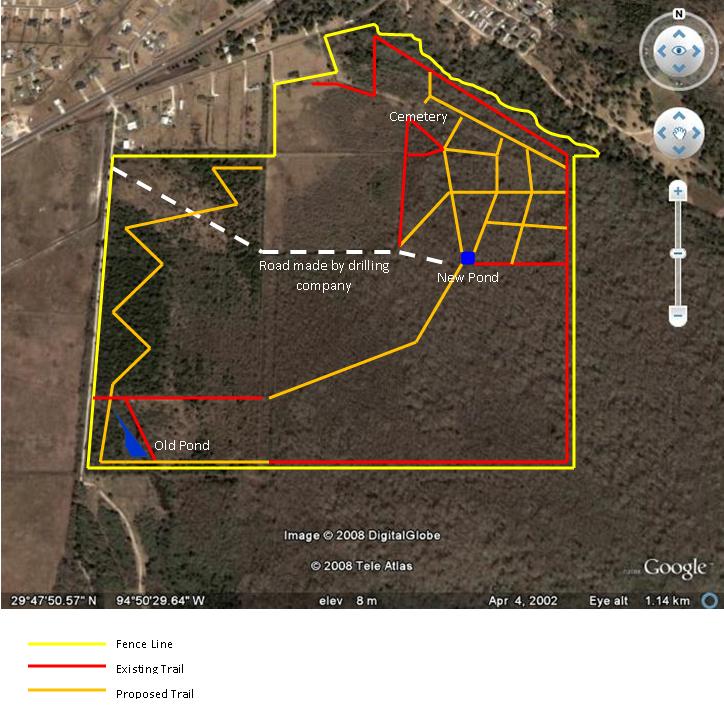
I went down into the woods to clear more on the trails. We finally got through with the first one! It looks great and will be easy to walk on. There are several big trees on either side of the trail. It connects the new pond to the trail around the fence line. We've got a little clearing to do on the fence line now. Tallow trees have grown up in the trail and a tree fell across the fence. I don't think it will be too hard to clear it. Here's a map of the property with the existing trails and proposed trails.
 While we were down in the woods, two Hermit Thrushes were chasing each other. They seemed oblivious to our presence and came close several times. Yellow-rumped Warblers were everywhere. Eastern Phoebes and Northern Flickers called from the treetops. I am still waiting to see Ruby-crowned Kinglets. Maybe if I just went birding instead of being in the woods with a chainsaw. Hmmm . . .
PFW Week 1 (Total Species - 11):
Eurasian Collared-Dove - 5
Mourning Dove - 1
Red-bellied Woodpecker - 1
Blue Jay - 1
Carolina Chickadee - 2
Tufted Titmouse - 2
Carolina Wren - 1
Eastern Bluebird - 1
Pine Warbler - 1
Northern Cardinal - 2
House Sparrow - 12
I went down into the woods to clear more on the trails. We finally got through with the first one! It looks great and will be easy to walk on. There are several big trees on either side of the trail. It connects the new pond to the trail around the fence line. We've got a little clearing to do on the fence line now. Tallow trees have grown up in the trail and a tree fell across the fence. I don't think it will be too hard to clear it. Here's a map of the property with the existing trails and proposed trails.
 While we were down in the woods, two Hermit Thrushes were chasing each other. They seemed oblivious to our presence and came close several times. Yellow-rumped Warblers were everywhere. Eastern Phoebes and Northern Flickers called from the treetops. I am still waiting to see Ruby-crowned Kinglets. Maybe if I just went birding instead of being in the woods with a chainsaw. Hmmm . . .
Tuesday, November 9, 2010
Time for Project FeederWatch
Project FeederWatch starts on Saturday, Nov. 13. I signed up again this year. It's fun to know that my observations are going to help the scientists at Cornell Lab of Ornithology understand the overall picture of the bird populations across the U.S. My count days will be Sundays and Mondays. If you're not familiar with Project FeederWatch (PFW), it is a program where people watch the birds for two consecutive days at their feeders, birdbaths, or anything they have put out specifically for birds and report the highest number at any given time. I am hoping that having the feeders in the woods and the ground feeder on the west side of my property will help the numbers of birds I see.
On Sunday, I noticed a sparrow that looked a little smaller than the House Sparrows at the ground feeder in my backyard. I grabbed my binoculars and saw the first Chipping Sparrow of the season. Several people have told me in the store that they have already had American Goldfinches coming to their feeder, so I went ahead and put out my thistle feeder. So far I haven't seen anything on it. I keep hoping every time I get my memory card from my BirdCam that I'll have a picture of a Red-breasted Nuthatch on the feeder, but no luck on that yet. The wintering birds have arrived in good numbers. Yesterday there were Yellow-rumped Warblers all over the place. Eastern Phoebes were calling. I saw a Hermit Thrush last week. Northern Flickers make their presence known with their cirr call. I still haven't seen any Ruby-crowned Kinglets or Yellow-bellied Sapsuckers.
The boys and I have begun clearing trails in the woods to make walking easier and give us access to different parts of the woods. As we go, I'm cutting wood for firewood. We got within 30 feet of finishing our first trail yesterday, but darkness got us before we could finish. We should be able to get that done on Sunday pretty quickly. There are several small tallow trees to cut out and one pretty good size one in the way. I'm hoping by spring migration to have several trails cut through the woods. It would be nice to be able to get to areas now where walking is nearly impossible because of all the blackberry vines and trees that have fallen.
Here are a couple of pictures of a Tufted Titmouse on one of the feeders in the woods. I just love these little birds!


On Sunday, I noticed a sparrow that looked a little smaller than the House Sparrows at the ground feeder in my backyard. I grabbed my binoculars and saw the first Chipping Sparrow of the season. Several people have told me in the store that they have already had American Goldfinches coming to their feeder, so I went ahead and put out my thistle feeder. So far I haven't seen anything on it. I keep hoping every time I get my memory card from my BirdCam that I'll have a picture of a Red-breasted Nuthatch on the feeder, but no luck on that yet. The wintering birds have arrived in good numbers. Yesterday there were Yellow-rumped Warblers all over the place. Eastern Phoebes were calling. I saw a Hermit Thrush last week. Northern Flickers make their presence known with their cirr call. I still haven't seen any Ruby-crowned Kinglets or Yellow-bellied Sapsuckers.
The boys and I have begun clearing trails in the woods to make walking easier and give us access to different parts of the woods. As we go, I'm cutting wood for firewood. We got within 30 feet of finishing our first trail yesterday, but darkness got us before we could finish. We should be able to get that done on Sunday pretty quickly. There are several small tallow trees to cut out and one pretty good size one in the way. I'm hoping by spring migration to have several trails cut through the woods. It would be nice to be able to get to areas now where walking is nearly impossible because of all the blackberry vines and trees that have fallen.
Here are a couple of pictures of a Tufted Titmouse on one of the feeders in the woods. I just love these little birds!


Tuesday, March 30, 2010
Recliner Birding
I spent yesterday in a recliner in front of our backdoor watching the birds at our feeders because of hyper-extending my knee pretty badly on Sunday. There was no way I could have walked in the woods. The worst part is it was an absolutely gorgeous day! Sigh . . .
But, the day wasn't completely without highlights! Pretty early in the morning, a Dickcissel showed up in the tree behind my feeders. I got some excellent looks at him. Later, he hopped down to my ground feeder and ate some of the millet there. He went to my birdbath a couple of times and drank from it. I got several really good looks at him, as did my wife and kids. I checked the UTC Checklist and Dickcissels aren't even mentioned to be here at the end of March, so this little guy was very early. The first week of April it's considered uncommon and then common by the second week of April. I guess he wanted to get a jump on all the other Dickcissels and get some good territory to nest in! He was only the second Dickcissel I have seen on the property in nearly seven years. It was neat to enter the Dickcissel into my Project FeederWatch records. When I was finished, they very politely wanted me to go back and confirm that I actually meant Dickcissel because their records show it is early for my area.
American Goldfinches were coming to the feeders. I had five of them. One of the males had nearly completed his molt into breeding plumage. There was one streak of the light brown on his chest. The rest of his plumage was breathtaking! A House Wren has found my suet and visited several times yesterday. Also, a male and female Yellow-rumped Warbler ate from the suet throughout the day. The male has changed into his breeding plumage. I always enjoy seeing them in that plumage because we don't get to see them like that very often. Like the goldfinches, they leave about the time they molt.
Several Northern Rough-winged Swallows flew over. That was the first time I've seen them this year. Cattle Egrets were following the cows in the pasture. A Pileated Woodpecker flew across the pasture on his way to the woods. The numbers of Mourning Doves and Eurasian Collared-Doves is going up at my feeders. I had four of each yesterday. The most I saw all winter of each was two.
The eggs in the Eastern Bluebird nest should hatch on Wednesday or Thursday. I'll walk/hobble over there to see what's going on with them on Wednesday afternoon.
Birds seen 3/29/10 (22 species): Little Blue Heron, Cattle Egret, Turkey Vulture, Red-shouldered Hawk, Eurasian Collared-Dove, Mourning Dove, Red-bellied Woodpecker, Pileated Woodpecker, Blue Jay, American Crow, Northern Rough-winged Swallow (FOS), Carolina Chickadee, House Wren, Blue-gray Gnatcatcher, Eastern Bluebird, Yellow-rumped Warbler, Chipping Sparrow, Northern Cardinal, Dickcissel (FOS), Red-winged Blackbird, American Goldfinch, House Sparrow
But, the day wasn't completely without highlights! Pretty early in the morning, a Dickcissel showed up in the tree behind my feeders. I got some excellent looks at him. Later, he hopped down to my ground feeder and ate some of the millet there. He went to my birdbath a couple of times and drank from it. I got several really good looks at him, as did my wife and kids. I checked the UTC Checklist and Dickcissels aren't even mentioned to be here at the end of March, so this little guy was very early. The first week of April it's considered uncommon and then common by the second week of April. I guess he wanted to get a jump on all the other Dickcissels and get some good territory to nest in! He was only the second Dickcissel I have seen on the property in nearly seven years. It was neat to enter the Dickcissel into my Project FeederWatch records. When I was finished, they very politely wanted me to go back and confirm that I actually meant Dickcissel because their records show it is early for my area.
American Goldfinches were coming to the feeders. I had five of them. One of the males had nearly completed his molt into breeding plumage. There was one streak of the light brown on his chest. The rest of his plumage was breathtaking! A House Wren has found my suet and visited several times yesterday. Also, a male and female Yellow-rumped Warbler ate from the suet throughout the day. The male has changed into his breeding plumage. I always enjoy seeing them in that plumage because we don't get to see them like that very often. Like the goldfinches, they leave about the time they molt.
Several Northern Rough-winged Swallows flew over. That was the first time I've seen them this year. Cattle Egrets were following the cows in the pasture. A Pileated Woodpecker flew across the pasture on his way to the woods. The numbers of Mourning Doves and Eurasian Collared-Doves is going up at my feeders. I had four of each yesterday. The most I saw all winter of each was two.
The eggs in the Eastern Bluebird nest should hatch on Wednesday or Thursday. I'll walk/hobble over there to see what's going on with them on Wednesday afternoon.
Birds seen 3/29/10 (22 species): Little Blue Heron, Cattle Egret, Turkey Vulture, Red-shouldered Hawk, Eurasian Collared-Dove, Mourning Dove, Red-bellied Woodpecker, Pileated Woodpecker, Blue Jay, American Crow, Northern Rough-winged Swallow (FOS), Carolina Chickadee, House Wren, Blue-gray Gnatcatcher, Eastern Bluebird, Yellow-rumped Warbler, Chipping Sparrow, Northern Cardinal, Dickcissel (FOS), Red-winged Blackbird, American Goldfinch, House Sparrow
Monday, November 30, 2009
Project FeederWatch 3rd Weekend
The third weekend of our Project FeederWatch was fun! On Sunday morning, we added four more species to our PFW list. A House Wren was checking out the brush pile. He spent quite a bit of time around it. Yellow-rumped Warblers, American Robins and Cedar Waxwings all used the birdbath. The Cedar Waxwings were the FOS of the winter season for me. There were about 50 of them in the tree in the backyard and about eight visited the birdbath. I hope they come back more often. The rest of the birds were pretty normal. The Chipping Sparrow population has increased quite a bit. We had 21 of them on the ground feeder at one time yesterday. An American Goldfinch visited the Nyjer feeder yesterday and was back this morning. Hopefully he'll hang around and bring his friends with him.
Birds that we didn't count on the PFW list included more Tree Swallows. There were 10 to 15 flying around over the pasture. Six Eastern Bluebirds were on the power lines out front. American Crows made their presence known around the area where the cows are fed. A Red-bellied Woodpecker dined on the tallow seeds.
This morning has been cold and wet. We haven't had many birds at the feeders. Several Yellow-rumped Warblers were in the hackberry tree behind the house. Fox squirrels have been at the ground feeder several times this morning and that makes the birds a little nervous to be there with them. I've also seen a Sharp-shinned Hawk make several passes over the yard and that will definitely make the birds nervous.
Birds Seen 11/29/09 (15 species): Sharp-shinned Hawk, Red-shouldered Hawk, Eurasian Collared-Dove, Red-bellied Woodpecker, American Crow, Tree Swallow, House Wren, Eastern Bluebird, American Robin, Cedar Waxwing, Yellow-rumped Warbler, Chipping Sparrow, Northern Cardinal, American Goldfinch, House Sparrow
Birds that we didn't count on the PFW list included more Tree Swallows. There were 10 to 15 flying around over the pasture. Six Eastern Bluebirds were on the power lines out front. American Crows made their presence known around the area where the cows are fed. A Red-bellied Woodpecker dined on the tallow seeds.
This morning has been cold and wet. We haven't had many birds at the feeders. Several Yellow-rumped Warblers were in the hackberry tree behind the house. Fox squirrels have been at the ground feeder several times this morning and that makes the birds a little nervous to be there with them. I've also seen a Sharp-shinned Hawk make several passes over the yard and that will definitely make the birds nervous.
Birds Seen 11/29/09 (15 species): Sharp-shinned Hawk, Red-shouldered Hawk, Eurasian Collared-Dove, Red-bellied Woodpecker, American Crow, Tree Swallow, House Wren, Eastern Bluebird, American Robin, Cedar Waxwing, Yellow-rumped Warbler, Chipping Sparrow, Northern Cardinal, American Goldfinch, House Sparrow
Sunday, November 22, 2009
Project FeederWatch Day 3
Today was a little better. It was cool this morning and quite a few birds came in. Two cardinals, two Eurasian Collared-Doves, six Chipping Sparrows, one Mourning Dove, eight House Sparrows and one Common Grackle visited the feeders. I kept hoping one of the Yellow-rumped Warblers would visit the water so we could count them.
I think I'm going to get up early in the morning and go birding in the woods for a little bit. I'm curious to see how many more winter migrants have come in. I also want to check the pond to see if any ducks are hanging out down there. There are several more plants around the edges, so they may feel a little more comfortable.
I think I'm going to get up early in the morning and go birding in the woods for a little bit. I'm curious to see how many more winter migrants have come in. I also want to check the pond to see if any ducks are hanging out down there. There are several more plants around the edges, so they may feel a little more comfortable.
Monday, November 16, 2009
Raptors! Raptors! Raptors!
Our second day of Project FeederWatch was a little more productive, but not much. We added Northern Cardinal and Eurasian Collared-Dove to our list. It was nice to see the cardinal out there because I haven't seen one regularly in weeks. Hopefully they'll start coming back a little more.
I did watch the rest of the birds around the house today and it was the day of the raptors! I saw six species of raptors flying around or over the house this afternoon. Osprey, Sharp-shinned Hawk, Cooper's Hawk, Red-shouldered Hawk, Red-tailed Hawk and Merlin. The Merlin was perched on a utility pole. He stayed long enough to allow me to get my scope and get some good close-ups. The Sharp-shinned Hawk snagged a House Sparrow at the feeder this morning.
Overall, I saw fifteen species of birds today. It was fun even though I didn't get to get out and go birdwatching.
Birds Seen 11/16/09 (15 species): Black Vulture, Turkey Vulture, Osprey, Sharp-shinned Hawk, Cooper's Hawk. Red-shouldered Hawk, Red-tailed Hawk, Merlin, Eurasian Collared-Dove, Red-bellied Woodpecker, Eastern Phoebe, Yellow-rumped Warbler, Northern Cardinal, Red-winged Blackbird, House Sparrow
I did watch the rest of the birds around the house today and it was the day of the raptors! I saw six species of raptors flying around or over the house this afternoon. Osprey, Sharp-shinned Hawk, Cooper's Hawk, Red-shouldered Hawk, Red-tailed Hawk and Merlin. The Merlin was perched on a utility pole. He stayed long enough to allow me to get my scope and get some good close-ups. The Sharp-shinned Hawk snagged a House Sparrow at the feeder this morning.
Overall, I saw fifteen species of birds today. It was fun even though I didn't get to get out and go birdwatching.
Birds Seen 11/16/09 (15 species): Black Vulture, Turkey Vulture, Osprey, Sharp-shinned Hawk, Cooper's Hawk. Red-shouldered Hawk, Red-tailed Hawk, Merlin, Eurasian Collared-Dove, Red-bellied Woodpecker, Eastern Phoebe, Yellow-rumped Warbler, Northern Cardinal, Red-winged Blackbird, House Sparrow
Sunday, November 15, 2009
Project FeederWatch Day 1
Our Project FeederWatch started off pretty slowly today. A male Sharp-shinned Hawk chased the House Sparrows for a little while. He hung around the feeders for a while, so they were pretty quiet. He must have left because the House Sparrows came back along with a couple of Chipping Sparrows. That was it. Maybe things will pick up a little more tomorrow.
Project FeederWatch
Project FeederWatch began this weekend. It's a six-month long survey of birds that visit feeders, water and other things provided by people for them. Our count starts today. This year, instead of just seeing what birds come, we're going to keep a record of which feeders they visit. It's an added piece of information for us to see which of our feeders are most commonly used and which aren't used very much. I think it's going to be a lot of fun for us.
I have seen most of the winter migrants in the area now. An Eastern Phoebe hangs out around the house quite a bit. Yellow-rumped Warblers are in the tops of the trees along with Ruby-crowned Kinglets. Occasionally I'll hear a Northern Flicker calling from in the woods. I sure wish one of them would find my feeders! That would be cool! I'm hoping the Yellow-bellied Sapsucker finds me again this year. It won't be long before the American Goldfinches begin coming to the feeders. They're in the area and a few people have them at their feeders already. That's a little earlier than usual. It will be interesting to see if the National Weather Service's prediction of a cooler, wetter winter comes true and how that influences the birds.
I have seen between ten and twelve Eastern Bluebirds around and in my yard over the past couple of weeks. I'm really hoping for two pairs of them to nest this spring. It's so fun to listen to their call as they're flying overhead.
It's daylight now, so I'm going to start watching the feeders!
I have seen most of the winter migrants in the area now. An Eastern Phoebe hangs out around the house quite a bit. Yellow-rumped Warblers are in the tops of the trees along with Ruby-crowned Kinglets. Occasionally I'll hear a Northern Flicker calling from in the woods. I sure wish one of them would find my feeders! That would be cool! I'm hoping the Yellow-bellied Sapsucker finds me again this year. It won't be long before the American Goldfinches begin coming to the feeders. They're in the area and a few people have them at their feeders already. That's a little earlier than usual. It will be interesting to see if the National Weather Service's prediction of a cooler, wetter winter comes true and how that influences the birds.
I have seen between ten and twelve Eastern Bluebirds around and in my yard over the past couple of weeks. I'm really hoping for two pairs of them to nest this spring. It's so fun to listen to their call as they're flying overhead.
It's daylight now, so I'm going to start watching the feeders!
Saturday, October 17, 2009
Nighttime Birding with Cooler Temps
Last night, the kids and I decided to enjoy the cooler temperatures and went outside. We got a fire going in the chiminea and just sat around it visiting. It was amazing to me how many Indigo Buntings I heard flying overhead. After hearing probably 20 of them, I started keeping count of how many calls I heard. It was well over 50 in about two hours. There was also a strange call that I heard that I couldn't identify. It sounded closest to a Whooping Crane, but not exactly. I'm not ready to write that down on my list from the call. It was definitely something I've never heard before. I also heard a Killdeer (which isn't that uncommon at night around here) and what sounded like a Green Heron.
Yesterday was the first day after the cool front came through, and I still had two hummingbirds at the feeders. I'll be interested to see how many stick around. On Monday, I'm going to work at building up my brush pile a little bit to provide some cover for the wintering sparrows while they're here. I'm also going to get some plywood for a ground feeder for them.
I signed the kids and me up for Project Feederwatch. It's sponsored by Cornell Lab of Ornithology. Basically you pick two consecutive days of the week to watch the birds in your backyard from November through April. If the bird is attracted by something you've done for them - coming to a feeder, coming to water you've provided for them, coming to berry-producing plants you have planted - then you count those birds. There are some special rules about how to count the birds that you have to follow. It will be a fun project for us to be involved in. I'm thinking of doing an Excel spreadsheet for our own records to see what the winter bird population does from year to year at our feeders. It's a fun project for the whole family that allows regular people to contribute scientific information to help those at Cornell.
Yesterday was the first day after the cool front came through, and I still had two hummingbirds at the feeders. I'll be interested to see how many stick around. On Monday, I'm going to work at building up my brush pile a little bit to provide some cover for the wintering sparrows while they're here. I'm also going to get some plywood for a ground feeder for them.
I signed the kids and me up for Project Feederwatch. It's sponsored by Cornell Lab of Ornithology. Basically you pick two consecutive days of the week to watch the birds in your backyard from November through April. If the bird is attracted by something you've done for them - coming to a feeder, coming to water you've provided for them, coming to berry-producing plants you have planted - then you count those birds. There are some special rules about how to count the birds that you have to follow. It will be a fun project for us to be involved in. I'm thinking of doing an Excel spreadsheet for our own records to see what the winter bird population does from year to year at our feeders. It's a fun project for the whole family that allows regular people to contribute scientific information to help those at Cornell.
Subscribe to:
Posts (Atom)

 Posts
Posts


