Showing posts with label eastern bluebird nest. Show all posts

Monday, June 6, 2011

Nesting Birds and Low Water

The second brood of Eastern Bluebirds has hatched right on schedule! As of the evening of 6/5, three out of four eggs had hatched. They should fledge probably on the 22nd or 23rd.

Baby bluebirds on hatching day.

Mom and Dad bluebirds checking on their babies.

The Chimney Swifts have begun laying eggs. I couldn't see very clearly when I was checking, but I think they have laid one or two eggs as of 6/5. I'll take my binoculars and check soon. I'm glad to help them because they are heading toward threatened status with the changeover to metal flues, people capping their chimneys and not as many abandoned industrial smokestacks standing any longer.

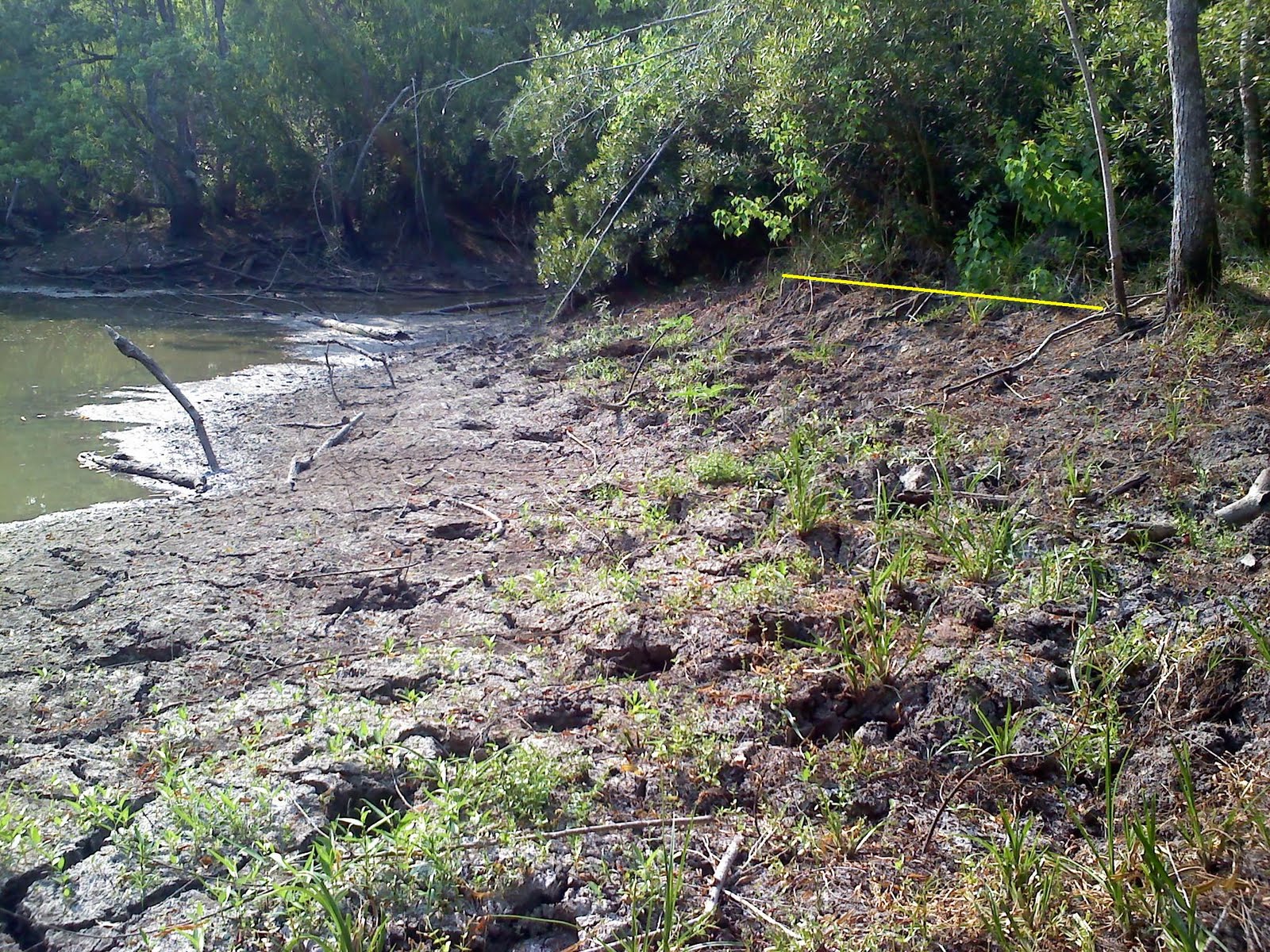
In other property news, the old pond is lower than I have ever seen it. The water is easily four feet lower than normal. I'm thinking I need to take the boys down there and do a little fishing and transfer some of the fish to the new pond which is holding water pretty well, although it's down about three feet. The new pond doesn't have nearly as many trees and plants around it taking the water more quickly. I think if we don't get rain in the next two to three weeks, the pond will be completely dry. If that happens, I'm going to get down there and clear out some of the fallen tree branches and other debris.

Pond on 6/5 with the normal water level drawn on the right.

Several birds have had successful nestings already this season. I have seen juvenile cardinals, Blue Jays, chickadees, titmice, woodpeckers and doves at the feeders. The Carolina Wrens that are nesting in a box on my aunt's carport are within a week of fledging. It's a fun time of year to see the young birds at the feeders figuring them out and begging for the parents to give them some food.

Tuesday, March 29, 2011

Quick Walk at the End of March

I took a quick walk in the woods on Monday. I didn't have a lot of time to spend birding. Fortunately it's still early in the spring, so I'm not missing a whole lot yet! The Barred Owl was in the same place he always is along the trail. It is fun to see him when I go down there. There are still quite a few winter residents around - Ruby-crowned Kinglet, Yellow-rumped Warbler, House Wren, American Goldfinch and White-throated Sparrow. The White-throated Sparrows are eating something in the trees. I regularly see them several feet up in the trees. As far as the spring migrants, I saw several Chimney Swifts flying over. I need to get on the roof and take the cover off my chimney. Purple Martins and Barn Swallows flew overhead feeding on flying insects. In the woods there were several Northern Parulas. I saw three at a time just west of the new pond. I heard a Hooded Warbler singing and finally found him in some of the thick understory. The warbler numbers should begin increasing significantly over the next couple of weeks. Indigo Buntings have begun to come into the area, so I should start seeing them at the feeders in the woods soon.

We have Eastern Bluebirds nesting again. The pair that had nested in my aunt's box were killed by a House Sparrow a month ago. Another pair has five eggs in the box in my yard now. I killed a wasp out of the box at Mom's, so I need to go over and check to see if that box is being utilized.

Birds Seen 3/28/11 (24 species):
Turkey Vulture, Mourning Dove, Barred Owl, Chimney Swift, Red-bellied Woodpecker, Pileated Woodpecker, White-eyed Vireo, Blue Jay, Purple Martin, Barn Swallow, Carolina Chickadee, Tufted Titmouse, Carlina Wren, House Wren, Ruby-crowned Kinglet, Eastern Bluebird, Northern Parula, Yellow-rumped Warbler, Hooded Warbler, White-throated Sparrow, Northern Cardinal, Red-winged Blackbird, American Goldfinch, House Sparrow

Friday, March 18, 2011

Spring!

Leaves are coming in on the trees. Warmer temperatures are here. My yard needs to be mowed. Birds are singing. All signs that spring is here! I have been walking in the woods as often as possible. On March 7 I saw the first Northern Parula of the season. They are typically the first of the wood warblers to migrate into the area. They nest in a tree right on the property line. It has a lot of Spanish moss. They build their nests in the tufts of moss. I have seen Purple Martins, Northern Rough-winged Swallows and Tree Swallows so far. Hooded Warblers, Black-and-white Warblers, Yellow-throated Warblers and Louisiana Waterthrushes should be showing up anytime now. A pair of Eastern Bluebirds has taken up residence in the nest box in our yard. Their nest was completed on Monday. I keep checking for an egg, but none so far. I've got my sparrow spooker ready to put on as soon as I see an egg in the nest. The Purple Martins that nested in my gourds last year haven't returned yet. I'm anxious for them to be back! I'm going to take the cover off my chimney this year and allow Chimney Swifts to nest in it. As new houses are constructed, metal flues instead of clay have been used leading to a loss of "habitat" for Chimney Swifts and their population has dwindled. So, I'm going to do my part to help out. I wish I could build a Chimney Swift tower, but it is cost-prohibitive.

I have checked my BirdCam at the feeders in the woods regularly, but only have Red-winged Blackbirds, Northern Cardinals, Carolina Chickadees, Tufted Titmice and Carolina Wrens. Indigo Buntings should start showing up next week and Painted Buntings should show up a week after that. They really show up in good numbers the second week of April along with Blue Grosbeaks and Rose-breasted Grosbeaks. I should get all of them at my feeders. I've been researching what I can feed to attract orioles and tanagers. I've read sunflower hearts for tanagers and suet or fruit for orioles. I'll have all that down there to see what shows up. I hope that some of the warblers find the Bark Butter and get their picture taken by the BirdCam.

I watched a couple of Red-shouldered Hawks flying around along the gully and found their nest. I hope I can get close enough with my camera to get some shots when they're feeding the chicks. That will be fun!

Several winter birds are still around. When I was walking yesterday, I saw Hermit Thrush, Orange-crowned Warbler, Yellow-rumped Warbler, Ruby-crowned Kinglets and American Goldfinches. It's a fun time of year to go birding!

Birds Seen 3/15 & 3/17 (38 species):
Great Egret, Black Vulture, Turkey Vulture, Red-shouldered Hawk, Mourning Dove, Barred Owl, Red-bellied Woodpecker, Yellow-bellied Sapsucker, Downy Woodpecker, Pileated Woodpecker, Eastern Phoebe, White-eyed Vireo, Blue Jay, Purple Martin, Tree Swallow, Northern Rough-winged Swallow, Carolina Chickadee, Tufted Titmouse, Carolina Wren, Ruby-crowned Kinglet, Blue-gray Gnatcatcher, Eastern Bluebird, Hermit Thrush, Gray Catbird, Northern Mockingbird, Orange-crowned Warbler, Northern Parula, Yellow-rumped Warbler, Chipping Sparrow, Song Sparrow, White-throated Sparrow, Dark-eyed Junco, Northern Cardinal, Red-winged Blackbird, Common Grackle, Great-tailed Grackle, American Goldfinch, House Sparrow

Tuesday, June 15, 2010

Summertime Birding

Summertime in Southeast Texas can be boring as far as birdwatching goes. The excitement of spring migration is over. The birds that are here are breeding birds and they can be seen most of the time. But, summer holds rewards that no other time of year does. Watching cardinals feed their young ones at the feeder is one. The Red-bellied Woodpeckers have brought their young ones to the feeder and are teaching them how to find food. Purple Martins and Eastern Bluebirds have chicks in the nest. The Purple Martin chicks should fledge on June 24 and the bluebird chicks should fledge on June 27. It's so fun to watch the juvenile bluebirds as they learn to use the birdbath in my backyard. As the summer progresses, the anticipation for the fall Ruby-throated Hummingbird migration builds. We normally see their numbers greatly increase late August into September and October. Summer is just a different kind of activity. I think we try to convince ourselves that nothing is going on so we don't have to deal with the heat and mosquitoes.

I set up some feeders down in the woods. I had an extra pole and decided to use it for that purpose rather than holding our windchime. Within five days of putting it up, I noticed that several seeds were cracked and something had been eating the peanuts. I went down on Friday afternoon and watched them for a while. After fifteen minutes, a group of Tufted Titmice and Carolina Chickadees came through and visited the feeders. The titmice were feeding young ones. They were the only ones I saw at the feeders, although cardinals and woodpeckers were nearby. Hopefully I'll purchase an Audubon Wingscapes BirdCam soon and be able to put it down there to take pictures of the birds. While watching the feeders, a Yellow-billed Cuckoo was flying around in the canopy. I watched him catch a katydid and eat it. That was fun to observe him. I had hoped that he would catch an insect and take it to a nest, but he didn't. I'll go back down there soon and watch for him to do that.

The Eastern Bluebirds seem to be doing well. They fledged five in their first brood. Then they hatched five more eggs in the second brood. Unfortunately, House Sparrows got into the nest and killed the chicks. So, the bluebirds decided to try again and laid five more eggs. I purchased a Sparrow Spooker to keep the sparrows out of the nest. Four out of the five eggs hatched this time. The chicks look very healthy.

On my way to check the bluebird nest one day, a female Killdeer began performing her "broken wing" display. That is a defense display to lure potential predators away from the nest thinking they'll have an easy meal of an injured bird. I began to look closely where I was stepping and found four eggs neatly arranged on the ground. I put a marker near the nest to make sure they do not get destroyed by a lawnmower. I have no idea how long they've been there so I don't know when to expect them to hatch.

The three Purple Martin chicks are two weeks old now. They'll be in the nest for another nine days. I still only have one pair. This year was weird for martins returning. Many people reported the martins arrived very late at their colonies. That was the case here. Most of the time the adults return in February. It was early May when mine returned. I had given up on having martins this year. Hopefully next year will be more normal and I'll have several pairs.

We planted several shrubs yesterday. As I watered them in, several birds came and enjoyed a cool shower. Northern Cardinals, Northern Mockingbirds and House Sparrows bathed in the sprinkles. I need to set up my mister in the trees and give them a place to bathe. They love getting under the water dripping off the leaves. It also helps keep them cool on hot summer days.

Sunday, May 23, 2010

Spring Migration Wrap-up

Spring migration has come and gone. Now instead of seeing reports of the migrants people are seeing, we start seeing the results of breeding bird surveys. I have never really tried to find breeding birds on our property. A couple of years ago, I happened to look up and see a Yellow-billed Cuckoo sitting on a nest. Last year I found a tuft of Spanish moss where a pair of Northern Parula had built a nest. I know that Hooded Warblers, Kentucky Warblers, Red-eyed Vireos and Summer Tanagers nest here, so they should be out there. Most of the time it's just too hot and the mosquitoes are too bad to spend the time in the woods to find the nests.

I had a good spring on the property. I saw 21 species of warblers, both tanagers, both buntings and both orioles. I saw all of the thrushes that migrate through here, as well as all of the swallows. I did miss several warblers that I normally expect to see - Yellow-throated Warbler, Canada Warbler, American Redstart, Ovenbird, Swainson's Warbler, Golden-winged Warbler and Yellow Warbler. I added one property bird to my list this spring - Prothonotary Warbler. That brings my property list to 194. I missed seeing a Philadelphia Vireo and Warbling Vireo on the property this year, although I saw them at High Island. The best bird of the spring for me was the Fork-tailed Flycatcher seen at Smith Oaks in High Island. They normally don't range farther north than central Mexico. We had a period of strong west winds that brought several rarities to the Upper Texas Coast including the flycatcher. Overall spring migration was a lot of fun this year.

The last time I checked the Purple Martin nest, they still had three eggs in it. There was a lot of activity today with some SY martins flying around the gourd. The male and female that have the nest in it were trying to make them leave. I didn't check the nest today. I did check the Eastern Bluebird nest and found it empty. The babies should be a week old today and not nearly ready to leave the nest. I blame House Sparrows for this one. I'm going to make a sparrow spooker and see if I can keep the sparrows out of the nest in the future. I am intensifying my trapping and hope to take care of the sparrows around here.

Tuesday, May 11, 2010

Last Days of Spring Migration

Walking in the woods was a joy yesterday. The sweet smells of Chinese privet and honeysuckle filled the air. The bees busily gathered nectar from the privet and grapevines. Giant Swallowtails, Pipevine Swallowtails and a couple of Monarchs also feasted on the flowers. The wind was strong and that made looking in the tops of the trees difficult. But, there were several birds in the woods. I added three new ones for the year - Bay-breasted Warbler, Magnolia Warbler and Acadian Flycatcher. I have probably seen the flycatcher before, but they look so similar to four other species of flycatcher that come through here that I don't count them unless I hear them call. The Magnolia Warbler was one of the first birds I saw as I entered the woods. He was hopping around in some yaupon thickets. It has always been my experience that when the Magnolia Warblers show up, migration is just about over. There were several throughout the woods. The Bay-breasted Warbler was hanging around with a mixed group of Carolina Chickadees and Red-eyed Vireos. Seeing him gave me what I like to call "The Big Three" for the year - Chestnut-sided Warbler, Blackburnian Warbler and Bay-breasted Warbler. I'm not sure what it is about those three that I like to see every year, but they are high on my list each migration. The Acadian Flycatcher was showing off his flycatching abilities along with an Eastern Wood-Pewee. He would fly off a dead branch, catch an insect, fly back to the branch and sing. It was a lot of fun watching him! I haven't seen nearly as many Indigo Buntings, so they must be moving on north. Several Yellow-billed Cuckoos called their frog-like call. Swallows and swifts flew overhead almost constantly. Kentucky Warblers and a Hooded Warbler called from deep within tangled understory.

The Purple Martins that showed up last Sunday have just about completed their nest in gourd #5 on my gourd rack. I keep checking hoping to see a pure white egg in the nest, but nothing yet. The SY male that has been trying to attract a female is still not giving up. He sits on top of the house and sings frequently. He may end up being an unmated bird this year, but will return next year and have more success. The unmated males actually serve a purpose at martin colonies. They will hang around throughout the breeding season. When the young martins fledge, these unmated males will harass them and give them a negative impression on the colony. Next year, those newly fledged birds will not return to their natal colony, but will join a new one or establish a new colony. The gene pool is kept much cleaner that way. So, unless a late-arriving female joins the SY male out there, I'll have one pair again, but should have more next year. Hopefully they'll arrive sooner next year and be here to sing their dawnsong to attract more SY birds to the colony.

The Eastern Bluebird eggs should hatch on Monday, May 17. There are five eggs again. I still haven't seen the young from the first brood. Normally they come to my birdbath within two or three weeks of fledging. I've seen the parents flying around, but the juveniles have been absent. I hope they're okay. The first year of life for a songbird is extremely perilous. Fewer than half of all the birds that hatch this year will live to see their first birthday. That's why they have so many at a time. I'm thinking of trying a time-lapse photo session with the bluebird chicks this time and seeing how it goes. I'll take pictures every day at the same time (weather permitting of course!) and then put them into my video editing software and creating a video that shows each day of their development. That could be fun. I hope they cooperate!

Birds seen 5/10/10 (37 species): Great Blue Heron, Cattle Egret, Roseate Spoonbill, Turkey Vulture, Red-shouldered Hawk, Eurasian Collared-Dove, White-winged Dove, Mourning Dove, Yellow-billed Cuckoo, Barred Owl, Chimney Swift, Ruby-throated Hummingbird, Red-bellied Woodpecker, Pileated Woodpecker, Eastern Wood-Pewee, Acadian Flycatcher*, White-eyed Vireo, Red-eyed Vireo, Blue Jay, American Crow, Purple Martin, Northern Rough-winged Swallow, Barn Swallow, Carolina Chickadee, Carolina Wren, Eastern Bluebird, European Starling, Northern Parula, Chestnut-sided Warbler, Magnolia Warbler*, Bay-breasted Warbler*, Kentucky Warbler, Hooded Warbler, Northern Cardinal, Indigo Bunting, Red-winged Blackbird, House Sparrow

Monday, May 3, 2010

Best Day of the Year!


Today has probably been the best day of the year for me. I didn't see a new species. I didn't have a record high species count for the property. Today was the best day because the Purple Martins that showed up yesterday are still around today! I had given up on having any martins in my housing this year. Yesterday an ASY male (left picture) and female (right picture) along with an SY male showed up and explored the gourds and the house. They were joined today by another SY male and female. I just love hearing their gurgling call as they fly around. It's so fun to have them!

I did get out and do a little birding this morning. The woods were pretty dead as far as activity goes. There were a few warblers singing on territory - Hooded, Kentucky, Northern Parula. A Summer tanager sang from high in the tree tops. A late Chipping Sparrow chipped from a cedar tree. A juvenile male Painted Bunting sang from a clump of thick vegetation. An Eastern Wood-Pewee and a Yellow-billed Cuckoo sang on the trail near the new pond. It's getting to that time of year when I stop seeing new things and start hearing the nesting birds singing. I watched the Red-shouldered Hawks flying around and finally found the nest. I couldn't see in it very well because it was obscured by leaves. I couldn't tell if there were chicks in the nest or not. I'll keep watching it.

The Eastern Bluebirds have four eggs in their nest. The second brood is well underway! If they lay five eggs, they should hatch sometime around May 17. I haven't seen any of the first brood flying around yet. Normally the parents will bring them to my water, but so far I haven't seen them. It probably won't be long, especially when the parents have another brood in the nest box to feed.

Birds Seen 5/3/10 (41 species): American White Pelican, Double-crested Cormorant, Great Egret, Little Blue Heron, Cattle Egret, White Ibis, Black Vulture, Turkey Vulture, Red-shouldered Hawk, Laughing Gull, Eurasian Collared-Dove, White-winged Dove, Mourning Dove, Yellow-billed Cuckoo, Chimney Swift, Ruby-throated Hummingbird, Red-bellied Woodpecker, Eastern Wood-Pewee, White-eyed Vireo, Blue Jay, American Crow, Purple Martin, Northern Rough-winged Swallow, Barn Swallow, Carolina Chickadee, Tufted Titmouse, Carolina Wren, Eastern Bluebird, Northern Mockingbird, Cedar Waxwing, Northern Parula, Black-and-white Warbler, Kentucky Warbler, Hooded Warbler, Summer Tanager, Chipping Sparrow, Northern Cardinal, Indigo Bunting, Painted Bunting, Red-winged Blackbird, House Sparrow

Tuesday, April 27, 2010

Three More Year Birds

I went into the woods on Monday hoping it would be a little more active than I found on Sunday. Unfortunately, the birds just weren't there. Even with the strong northwest winds, the birds just weren't there. I thought they might have sat tight for the night with those winds, but I guess they decided to go on. I did add three new ones for the year. A Yellow-billed Cuckoo foraged in an oak tree right above the trail giving me some great looks at him. A Veery skulked beneath a thicket of yaupon. A Chestnut-sided Warbler announced his presence with his song, leading me directly to him. Indigo Buntings continue to have a strong showing, including on my feeders. I saw several individuals including females at my feeders yesterday.

For years I had tried to attract woodpeckers to my feeders. I blogged a few weeks about about Jim's Birdacious Bark Butter and how it finally got Red-bellied Woodpeckers to my feeders. Now I'm using a Cranberry Fare seed cylinder from Wild Birds Unlimited and have really had some great luck with it! The ingredients are pecans, sunflower chips, peanuts, safflower, black oil sunflower and cranberries and they're put together with gelatin. The woodpeckers almost exclusively feed from it now. Blue Jay, Northern Cardinal, Indigo Bunting, House Sparrow, Carolina Chickadee, Red-winged Blackbird and American Goldfinch have been seen eating from it. The Eurasian Collared Doves and White-winged Doves seem to leave it alone since they can't eat from it easily because they don't peck at it to break parts out and their beaks aren't strong enough to pull the seeds off. They are content to pick up what is dropped to the ground below. It is a great product (can be ordered online through the Houston Wild Birds Unlimited web site) and is easy to use. If you've got a problem with White-winged Doves at your feeders, it can be a problem-solver!

Speaking of White-winged Doves, I have seen several of them lately. I had five of them at the feeders yesterday. For years I had two at the most. It seems they have moved out this way.

I checked the Eastern Bluebird nest box in my aunt's yard yesterday and found the beginnings of a nest. So, brood number two is on its way!

Birds Seen 4/26/10 (45 species): Cattle Egret, Black Vulture, Turkey Vulture, Red-shouldered Hawk, Laughing Gull, Eurasian Collared-Dove, White-winged Dove, Mourning Dove, Yellow-billed Cuckoo*, Barred Owl, Chimney Swift, Ruby-throated Hummingbird, Red-bellied Woodpecker, Downy Woodpecker, Pileated Woodpecker, Eastern Wood-Pewee, Great Crested Flycatcher, White-eyed Vireo, Blue Jay, American Crow, Purple Martin, Barn Swallow, Carolina Chickadee, Tufted Titmouse, Carolina Wren, Blue-gray Gnatcatcher, Eastern Bluebird, Veery*, Gray Catbird, Northern Mockingbird, Northern Parula, Chestnut-sided Warbler*, Black-and-white Warbler, Northern Waterthrush, Kentucky Warbler, Common Yellowthroat, Hooded Warbler, Yellow-breasted Chat, Summer Tanager, Northern Cardinal, Indigo Bunting, Dickcissel, Red-winged Blackbird, Brown-headed Cowbird, House Sparrow

* = First of Season

Tuesday, April 13, 2010

Bluebird Chicks - 14 Days Old

The bluebird chicks are 14 days old today. They have really gotten their feathers in. They should fledge either Saturday or Sunday. Hopefully this year we'll have a second brood. The first brood is fledging early enough where they should have plenty of time to start a second brood. Hopefully I can get some pictures of the fledglings when they come to the water in my backyard. It's fun to watch them following the male around learning how to live. Here's a picture of them at 14 days old.

Monday, April 5, 2010

New Property Bird - #194

I spent about three hours walking in the woods this morning. There was a lot of activity, but not a lot of migrants just yet. Just to the east of the new pond, several warblers and other birds were flying around. Most of them were Yellow-rumped Warblers, many in their breeding plumage. A Northern Parula called incessantly and came out several times to show off his brilliant plumage. Then my new property bird showed up. A Prothonotary Warbler was in the same tree as the parula. He gave me some great looks! I never would have thought I'd see a Black-throated Blue Warbler and Cape May Warbler on the property before a Prothonotary, but that's just the way it worked out. He is property bird #194. In a clump of yaupon trees just below the Prothonotary, a Worm-eating Warbler looked for insects. A female Hooded Warbler came in and out of the thicket. A Red-eyed Vireo and Black-and-white Warbler flew from tree to tree in search of breakfast. Swallows, martins and swifts flew overhead. On the way back in, an Osprey flew overhead.

The Eastern Bluebird chicks hatched on 3/30. I checked the box yesterday (4/4) and this is what they look like.
They're starting to get feathers in on their wings. They should fledge around April 17. I'll post more pictures over the next couple of weeks.

Here's a picture of Mr. Bluebird I took a while back.


Birds seen 4/5/10 (43 species): Great Blue Heron, Great Egret, Black Vulture, Turkey Vulture, Osprey, Cooper's Hawk, Red-shouldered Hawk, Mourning Dove, Barred Owl, Chimney Swift, Ruby-throated Hummingbird, Red-bellied Woodpecker, Downy Woodpecker, White-eyed Vireo, Red-eyed Vireo (FOS), Blue Jay, American Crow, Purple Martin, Northern Rough-winged Swallow, Barn Swallow, Carolina Chickadee, Tufted Titmouse, Carolina Wren, House Wren, Ruby-crowned Kinglet, Blue-gray Gnatcatcher, Eastern Bluebird, Hermit Thrush, American Robin, Gray Catbird, European Starling, Cedar Waxwing, Northern Parula, Yellow-rumped Warbler, Black-and-white Warbler, Prothonotary Warbler (FOS & new property bird), Worm-eating Warbler (FOS), Hooded Warbler, White-throated Sparrow, Northern Cardinal, Indigo Bunting (FOS), Red-winged Blackbird, House Sparrow

Monday, March 8, 2010

Spring!

I love spring! Watching the birds begin their territorial displays and courtship is so fun. I love to walk outside early in the morning and hear the chorus of cardinals, Carolina Wrens, White-eyed Vireos, bluebirds and robins ushering in the new day. Watching the birds at my feeders is fun too. Male cardinals will crack a safflower seed and feed the female. When another male cardinal comes to the feeders, a chase ensues to get the intruder out of the territory. It won't be long before the hummingbirds come to the feeders. Buntings and Rose-breasted Grosbeaks may come to the feeders. I am still hopeful the Purple Martins will return to the houses here. They seem to be late coming in across the board this year. Add to all that the anticipation of the upcoming migration of many songbirds heading from South America and Central America to their breeding grounds as far north as Canada. I always look forward to the trill of Northern Parulas singing to announce his territory and attract a mate. I look forward to finding Hooded Warblers skulking in the tangles of tri-foliate orange trees. I always feel my spring has been complete if I can see the trio of Chestnut-sided Warbler, Bay-breasted Warbler and Blackburnian Warbler. Last year I missed the Bay-breasted Warbler. I look forward to the breath-taking red on Scarlet Tanagers as they fly through the treetops in search of insects. And I'm always hopeful to see a male Painted Bunting. Spring is such a fun time of the year for birds!

The American Goldfinches are slowing down quite a bit at the feeders. I went from having 50+ last week to having fewer than 20 this week. I am always sad to see them go. They provide a lot of entertainment over the winter months. I did have a happy feeder story today. I have been spreading Jim's Birdacious Bark Butter on a tallow tree in the backyard. Bark Butter is a mixture of suet, peanuts and corn made by the CEO of Wild Birds Unlimited to attract Brown Creepers in his yard. I have seen woodpeckers in that tallow tree often and hoped they would eventually find the Bark Butter. This morning I watched a female Red-bellied Woodpecker go to the Bark Butter and eat from it. That is very exciting to me because I have never had any luck with attracting woodpeckers to my feeders. Other birds I have seen eating the Bark Butter are Pine Warblers, Yellow-rumped Warbler, Red-winged Blackbird and Carolina Wren. I'm looking forward to seeing what else finds it!

I checked the Eastern Bluebird box in my aunt's yard on Saturday and found a partially completed nest. This is the earliest I have seen a nesting attempt. There isn't any activity in the other boxes I have up yet, but some younger birds sometimes take a little longer to get going in the spring. I'm still hopeful it will happen.

Next week I will begin my weekly trips down into the woods to see the migrants that are coming through. I would go today, but it's raining. March 9 is the earliest date I have seen any of the migrant songbirds coming through. Normally I will see them beginning in the third week of March. I will post what I am see regularly.

Saturday, June 13, 2009

Property Stuff and Church Camp

On Saturday, June 6, I kept hearing a warbler-like call and finally found a male Yellow Warbler in the trees to the west of the house. I know I've never seen one here that late.

The juvenile Purple Martins are doing well. They should fledge between June 16 and June 18. Yesterday was the last day I could safely lower the gourds to check on them. The general rule of thumb is not to lower the housing once the babies reach 20 days old or you run the risk of premature fledging. So, I'll have to just wait and see what happens. Here's the last picture I got of them. It was kind of bitter-sweet seeing them for the last time. I'm looking forward to years of having Purple Martins nesting with me!


I spent Sunday through Thursday at the H.E. Butt Foundation Camp north of Leakey, TX at a church camp. I completely forgot my binoculars, but as it turns out I didn't need them at all. The most exciting bird I saw was an Ash-throated Flycatcher. He was life bird #368 for me. I was sitting by myself in the pavilion and he flew into a tree about 15 feet from me and sang. I listened to their call on my iPod and it matched perfectly. Two other pretty exciting birds for me were the Zone-tailed Hawk that flew along the cliffs that overlook our campsite. I could hear him early in the morning calling from the tree or rock where he perched and then he would fly and call. Also, Golden-cheeked Warblers were everywhere. Here's my list of birds I saw at the camp:

HEB Birds (27 species): Green Heron, Black Vulture, Turkey Vulture, Zone-tailed Hawk, Yellow-billed Cuckoo, Common Nighthawk, Chuck-will's-widow, Black-chinned Hummingbird, Ladder-backed Woodpecker, Ash-throated Flycatcher, Western Kingbird, White-eyed Vireo, Western Scrub-Jay, Common Raven, Cliff Swallow, Barn Swallow, Carolina Chickadee, Black-crested Titmouse, Canyon Wren, Bewick's Wren, Blue-gray Gnatcatcher, Northern Mockingbird, Golden-cheeked Warbler, Prothonotary Warbler, Summer Tanager, Northern Cardinal, Painted Bunting

I checked the bluebird nest box yesterday and there is no sign of a second brood being started at all. I'm surprised they haven't even started constructing a new nest. I'll keep checking.

Monday, May 11, 2009

Spring Migration 2009

Spring migration is winding down. Over the past few weeks we've had strong southerly winds at the surface which help the migrants fly right over us. Those that do stop only stop for a few hours to refuel and then take off again. The past two weeks that I went out, there were very few migrants to be seen. In fact, the woods were very quiet, with the exception of the hordes of mosquitoes. On May 1, the mosquitoes were so bad they literally chased me into the house. They weren't quite as bad on May 8, but the birds weren't there. If I had been a migrating bird and stopped here for a little bit of food, I wouldn't have stayed long either with as many mosquitoes as I would have had to deal with!

I ran a report of my spring numbers on the property. I ran the report from March 1 to May 8. I saw a total of 112 species. Here are the migrants I saw:

Swallow-tailed Kite, Mississippi Kite, Broad-winged Hawk, Swainson's Hawk, Upland Sandpiper, Black-billed Cuckoo, Yellow-billed Cuckoo, Chimney Swift, Ruby-throated Hummingbird, Eastern Wood-Pewee, Acadian Flycatcher, Great Crested Flycatcher, Eastern Kingbird, White-eyed Vireo, Yellow-throated Vireo, Blue-headed Vireo, Warbling Vireo, Philadelphia Vireo, Red-eyed Vireo, Purple Martin, Tree Swallow, Northern Rough-winged Swallow, Bank Swallow, Cliff Swallow, Barn Swallow, Gray-cheeked Thrush, Swainson's Thrush, Wood Thrush, Gray Catbird, Blue-winged Warbler, Tennessee Warbler, Orange-crowned Warbler, Northern Parula, Yellow Warbler, Chestnut-sided Warbler, Magnolia Warbler, Cape May Warbler, Black-throated Green Warbler, Blackburnian Warbler, Yellow-throated Warbler, Blackpoll Warbler, Cerulean Warbler, Black-and-white Warbler, American Redstart, Worm-eating Warbler, Ovenbird, Kentucky Warbler, Common Yellowthroat, Hooded Warbler, Canada Warbler, Yellow-breasted Chat, Summer Tanager, Scarlet Tanager, Rose-breasted Grosbeak, Blue Grosbeak, Indigo Bunting, Dickcissel, Orchard Oriole, Baltimore Oriole

It was a good spring for me on the property. I got 23 species of warblers (including Yellow-rumped which are winter residents, but do start changing into breeding plumage while here), both tanagers, both orioles, both grosbeaks and all of the swallows. I was a little disappointed in some of the species I missed, though. So far I haven't seen a Painted Bunting. Some of the warblers I missed include Louisiana Waterthrush, Northern Waterthrush, Bay-breasted Warbler, Golden-winged Warbler and Nashville Warbler. I didn't see a Veery, Chuck-will's-widow or Common Nighthawk (yet). There are always some misses every spring.

On a positive note, the Purple Martins have laid four eggs in the gourd. They laid the last one on Saturday, May 9 and the female started incubating that day. With the eggs taking 14 - 18 days to hatch, I have projected a hatching day for Sunday, May 24. I'll start checking them on the 22nd. I'm so excited to see them nesting with me!

The Eastern Bluebird chicks are doing well. All five of them are growing quickly. They should fledge on May 14 or 15. Then it will be onto the second brood! Here's a six-minute video I shot of the parents coming to feed the babies, and then of the babies at the end of the video. I actually shot an hour of video and was able to condense it to six minutes!

Thursday, May 7, 2009

Eggs!!!

I checked the gourd where the Purple Martins had been building their nest and there were two eggs in it! The first one was laid yesterday. It will be interesting to see how many eggs they lay being SY birds. At this point, I'm just excited to see eggs in the nest! I'll take some pictures when they've finished laying all the eggs.

The bluebird chicks are doing well. I checked them on Monday and they're getting their feathers in slowly. I need to check them again today and make sure they don't have any parasites affecting them.

Wednesday, April 29, 2009

Bluebirds Hatch and Purple Martins Build Nest

I checked on the bluebirds yesterday and the female was finally off the nest. All five eggs hatched! Here are a couple of pictures:


After I got the pictures of the bluebirds, I checked for any progress with the Purple Martins. They are slowly adding nesting material into one of the gourds. There was a lot of twigs and things that look like grass roots. They are beginning to add a little bit of mud as well. I'll know to start looking for eggs when the green leaves show up in the nest.

Sunday, April 26, 2009

Saturday, April 25

Saturday was windy still, but there were several migrants still around. I guess the deluge we had Friday night was enough to keep them grounded into Saturday morning. The gully that runs through our property was as high as I've ever seen it. It was way out of its banks in several places.

I entered the woods in one of the most productive spots and it was the most productive again. I added three FOS birds there - Magnolia Warbler, Blackpoll Warbler and Canada Warbler. There were a couple of Ovenbirds around. A Kentucky Warbler and a Hooded Warbler were singing on territory. A Chestnut-sided Warbler chattered as he looked in the leaves for some caterpillars. When I got down to the new pond, a Dickcissel flew in and called from some of the trees that were knocked down during the hurricane. That's only the second time I've ever seen a Dickcissel on the property, although I know they migrate through here. I've got good breeding habitat for them.

Speaking of breeding, the bluebird eggs haven't hatched yet. I checked them today and they are still unhatched. They should hatch in the next couple of days. The Purple Martins have begun putting nesting material in the gourd. Hopefully it won't be long they lay eggs. I observed the female plucking feathers from her brooding patch on Saturday.

Bird species seen 4/25/09 (39 species): Cattle Egret, Turkey Vulture, Red-shouldered Hawk, Laughing Gull, Eurasian Collared-Dove, Mourning Dove, Yellow-billed Cuckoo, Barred Owl, Chimney Swift, Ruby-throated Hummingbird, Red-bellied Woodpecker, White-eyed Vireo, Red-eyed Vireo, Blue Jay, Purple Martin, Carolina Chickadee, Tufted Titmouse, Carolina Wren, Ruby-crowned Kinglet, Eastern Bluebird, Northern Mockingbird, European Starling, Tennessee Warbler, Chestnut-sided Warbler, Magnolia Warbler (FOS), Blackpoll Warbler (FOS), Black-and-white Warbler, Ovenbird, Kentucky Warbler, Hooded Warbler, Canada Warbler (FOS), Yellow-breasted Chat, Scarlet Tanager, Northern Cardinal, Blue Grosbeak, Indigo Bunting, Dickcissel (FOS), Red-winged Blackbird, Brown-headed Cowbird

Friday, May 16, 2008

Oh Canada!

Spring migration is winding down, but it's not over yet. With the cool front passing through yesterday and 10-15 mph north winds all night and this morning, some of the late migrants were grounded today. All of the migrants that nest here were singing including Northern Parula, Hooded Warbler, Kentucky Warbler, Eastern Wood Pewee and Acadian Flycatcher. Several migrant warblers were flitting around in the trees fueling up for their journey north when southerly winds return. There were Magnolia, Chestnut-sided, American Redstart and the first Canada Warbler I've seen on the property this year. Yellow-billed Cuckoos finally have shown up and were calling in several places.

I was trying to find a little bird in some pretty thick tangles of tri-foliate orange and yaupon holly trees. I could see a little ways back in this particular spot. I could see a little dip in the ground. As I was looking for the little bird, a Green Heron hopped up out of the little dip. He's the first one of his species I have seen this year on the property.

When I came back in, I went to check the bluebird box. The female seemed a little apprehensive with me going toward it. They have begun constructing a new nest. This nest has a lot of pine needles in it. I would guess they are halfway through with their construction. We'll probably see eggs in the next seven to ten days.

Birds seen on May 16 (35 species): Little Blue Heron, Cattle Egret, Green Heron, White Ibis, Red-shouldered Hawk, Killdeer, Laughing Gull, Eurasian Collared-Dove, Yellow-billed Cuckoo, Ruby-throated Hummingbird, Red-bellied Woodpecker, Eastern Wood-Pewee, Acadian Flycatcher, White-eyed Vireo, Red-eyed Vireo, Blue Jay, Purple Martin, Northern Rough-winged Swallow, Barn Swallow, Carolina Chickadee, Tufted Titmouse, Carolina Wren, Eastern Bluebird, Northern Mockingbird, European Starling, Northern Parula, Chestnut-sided Warbler, Magnolia Warbler, American Redstart, Kentucky Warbler, Hooded Warbler, Canada Warbler, Northern Cardinal, Red-winged Blackbird, House Sparrow

'08 Property Birds as of May 16: 122
'04 Property Birds as of May 16: 105